

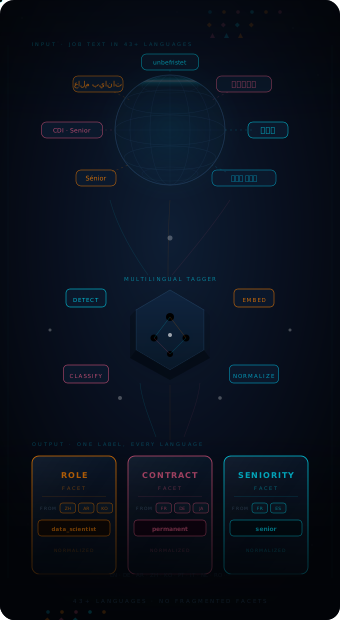
The Tagging API enriches profiles and job descriptions with searchable tags and database-ready categories (e.g., seniority, roles, industries, skills, education level, work authorization, work mode, and contract type). Powered by Hiring Superintelligence, it automatically classifies HR data across 43+ languages, giving you deterministic labels to power your faceted search and workflows.
Trusted by Customers, Partners & the AI Ecosystem






Get filterable labels, searchable facets, indexable tags, and analytics-ready categories to enrich your single source of truth. Submit any HR text and return Top-K tags with likelihood scores to prefill forms and automate routing without JSON drift. No JSON drift. No hallucinations. Only deterministic output values.
Inferred Skills
hard skills, soft skills
Contract Type
permanent, fixed-term, contractor, internship
Education Level
high school, bachelor's, master's, PhD
Seniority Level
intern, junior, mid, senior, lead, manager
O*NET
occupations, job families, tasks, skills, knowledge, abilities, work activities, tools & technology
ESCO
occupations, skills & competences (incl. knowledge + transversal + language skills), qualifications
France Travail ROME
job families, subfamilies, categories, titles
Custom Taxonomy
your company labels, work authorization, work mode, industries, sectors, functions, and more
1{ 2 "code": 200, 3 "message": "Tagging prediction ended successfully in 2 seconds!", 4 "data": [ 5 { 6 "ids": [ 7 "0" 8 ], 9 "predictions": [10 111 ],12 "tags": [13 "CDI"14 ]15 },16 {17 "ids": [18 "1"19 ],20 "predictions": [21 022 ],23 "tags": [24 "CDD"25 ]26 },27 {28 "ids": [29 "2"30 ],31 "predictions": [32 033 ],34 "tags": [35 "Stage"36 ]37 },38 {39 "ids": [40 "3"41 ],42 "predictions": [43 044 ],45 "tags": [46 "Alternance"47 ]48 },49 {50 "ids": [51 "4"52 ],53 "predictions": [54 055 ],56 "tags": [57 "Freelance"58 ]59 },60 {61 "ids": [62 "5"63 ],64 "predictions": [65 066 ],67 "tags": [68 "Intérim"69 ]70 }71 ]72}Pick the right API and model version for your needs— by use case, speed, precision, and cost.
The Dynamic Tagger (ZeroShot) enables on-the-fly taxonomy classification.
Standard Taggers (ESCO, O*NET, ROME) provide prebuilt normalization against widely used labor-market taxonomies. RAG Taggers enable taxonomy classification grounded in your own knowledge base.
| Algorithm | Data | Use Case | Speed | Precision | Languages | Taxonomy Size | |||||||
|---|---|---|---|---|---|---|---|---|---|---|---|---|---|
| Dynamic | Text | This Tagger can classify any HR text according to any input Taxonomy or list on the fly. Best for: when you have your own internal taxonomy. | 2s/request | A+ | 43 languages* | Max. 50 | |||||||
| Contract Type | Text | This Tagger can classify job descriptions, profiles, and work experiences into 6 standard contract types from HrFlow.ai Taxonomy. Best for: no internal taxonomy. | 100ms/request | A | EN, FR | 6 | |||||||
| Seniority | Text | This Tagger can classify job descriptions, profiles, and work experiences into 6 standard seniority levels from HrFlow.ai Taxonomy. Best for: no internal taxonomy. | 100ms/request | B | EN, FR | 6 | |||||||
| Degree | Text | This Tagger can classify job descriptions, profiles, and education sections into 7 standard degree levels from HrFlow.ai Taxonomy. Best for: no internal taxonomy. | 100ms/request | B | EN, FR | 7 | |||||||
| Rome4 Family | Text | This Tagger can classify job descriptions, profiles, and education sections into 14 Job families of the French National Labour Taxonomy (ROME 4.0). Best for: no internal taxonomy. | 100ms/request | B | EN, FR | 14 | |||||||
| Rome4 Sub-family | Text | This Tagger can classify job descriptions, profiles, and education sections into 110 job sectors of the French National Labour Taxonomy (ROME 4.0). Best for: no internal taxonomy. | 100ms/request | B | EN, FR | 110 | |||||||
| Rome4 Category | Text | This Tagger can classify job descriptions, profiles, and education sections into 1,056 job categories of the French National Labour Taxonomy (ROME 4.0). Best for: no internal taxonomy. | 100ms/request | B | EN, FR | 1056 | |||||||
| Rome4 Job-title | Text | This Tagger can classify job descriptions, profiles, and education sections into 12,107 job titles of the French National Labour Taxonomy (ROME 4.0). Best for: no internal taxonomy. | 100ms/request | C | EN, FR | 12107 | |||||||
Test the API in real-time with your own text. Get production-ready code in seconds.
Interactive testing environment
 Postman CollectionCollection
Enter texts to be enriched - such as job descriptions, work experience, and more.
Enter your API token or sign in to try the tagging demo.
{
  "code": 200,
  "message": "Tagging finished in 2s.",
  "data": [
    {
      "ids": ["0"],
      "predictions": [1],
      "tags": ["CDI"]
    },
    {
      "ids": ["1"],
      "predictions": [0],
      "tags": ["CDD"]
    }, ...
  ]
}Trusted by fast-growing HR Tech and Global Enterprise
We tried tagging with an LLM and prompts to prefill candidates’ forms, but labels drifted over time, and we still got occasional hallucinated tags.
HrFlow.ai Tagging gives deterministic categories with likelihood scores, so our database and search index stay stable in production.
Our in-house classifier looked good on day one, but retraining, drift monitoring, and taxonomy updates became a full-time job.
HrFlow.ai Tagging shipped production-grade taggers (ZeroShot/RAG/Trained) with consistent schema and <100ms latency—so we could focus on product, not ML ops.
We spent too much time maintaining mapping tables and exceptions to keep tags consistent.
HrFlow.ai Tagging understands semantics, and returns normalized labels with scores—so we stopped babysitting edge cases and got predictable outputs across regions.
We tried tagging with an LLM and prompts to prefill candidates’ forms, but labels drifted over time, and we still got occasional hallucinated tags.
HrFlow.ai Tagging gives deterministic categories with likelihood scores, so our database and search index stay stable in production.
Our in-house classifier looked good on day one, but retraining, drift monitoring, and taxonomy updates became a full-time job.
HrFlow.ai Tagging shipped production-grade taggers (ZeroShot/RAG/Trained) with consistent schema and <100ms latency—so we could focus on product, not ML ops.
We spent too much time maintaining mapping tables and exceptions to keep tags consistent.
HrFlow.ai Tagging understands semantics, and returns normalized labels with scores—so we stopped babysitting edge cases and got predictable outputs across regions.
We tried tagging with an LLM and prompts to prefill candidates’ forms, but labels drifted over time, and we still got occasional hallucinated tags.
HrFlow.ai Tagging gives deterministic categories with likelihood scores, so our database and search index stay stable in production.
Our in-house classifier looked good on day one, but retraining, drift monitoring, and taxonomy updates became a full-time job.
HrFlow.ai Tagging shipped production-grade taggers (ZeroShot/RAG/Trained) with consistent schema and <100ms latency—so we could focus on product, not ML ops.
We spent too much time maintaining mapping tables and exceptions to keep tags consistent.
HrFlow.ai Tagging understands semantics, and returns normalized labels with scores—so we stopped babysitting edge cases and got predictable outputs across regions.
We tried tagging with an LLM and prompts to prefill candidates’ forms, but labels drifted over time, and we still got occasional hallucinated tags.
HrFlow.ai Tagging gives deterministic categories with likelihood scores, so our database and search index stay stable in production.
Our in-house classifier looked good on day one, but retraining, drift monitoring, and taxonomy updates became a full-time job.
HrFlow.ai Tagging shipped production-grade taggers (ZeroShot/RAG/Trained) with consistent schema and <100ms latency—so we could focus on product, not ML ops.
We spent too much time maintaining mapping tables and exceptions to keep tags consistent.
HrFlow.ai Tagging understands semantics, and returns normalized labels with scores—so we stopped babysitting edge cases and got predictable outputs across regions.
Lightcast is built on very broad public data, but it didn’t let us build and use our own taxonomy from our company’s profile and job data, plus our competitors’ job posts.
HrFlow.ai let us create a dynamic internal taxonomy and tag against it through the Tagging API programmatically, so our labels matched our business reality.
Affinda felt like a ‘tag the whole profile’ box. We needed a reusable layer to tag each section—work experience, education, skills—with different taxonomies for higher precision.
HrFlow.ai’s tagger marketplace let us apply the right tagger to each section, making our fields and facets far more accurate.
We receive resumes in many languages, and DaXtra couldn’t cover all the languages we needed.
HrFlow.ai Tagging supported 43+ languages with normalized labels, so our search filters stayed consistent globally.
Lightcast is built on very broad public data, but it didn’t let us build and use our own taxonomy from our company’s profile and job data, plus our competitors’ job posts.
HrFlow.ai let us create a dynamic internal taxonomy and tag against it through the Tagging API programmatically, so our labels matched our business reality.
Affinda felt like a ‘tag the whole profile’ box. We needed a reusable layer to tag each section—work experience, education, skills—with different taxonomies for higher precision.
HrFlow.ai’s tagger marketplace let us apply the right tagger to each section, making our fields and facets far more accurate.
We receive resumes in many languages, and DaXtra couldn’t cover all the languages we needed.
HrFlow.ai Tagging supported 43+ languages with normalized labels, so our search filters stayed consistent globally.
Lightcast is built on very broad public data, but it didn’t let us build and use our own taxonomy from our company’s profile and job data, plus our competitors’ job posts.
HrFlow.ai let us create a dynamic internal taxonomy and tag against it through the Tagging API programmatically, so our labels matched our business reality.
Affinda felt like a ‘tag the whole profile’ box. We needed a reusable layer to tag each section—work experience, education, skills—with different taxonomies for higher precision.
HrFlow.ai’s tagger marketplace let us apply the right tagger to each section, making our fields and facets far more accurate.
We receive resumes in many languages, and DaXtra couldn’t cover all the languages we needed.
HrFlow.ai Tagging supported 43+ languages with normalized labels, so our search filters stayed consistent globally.
Lightcast is built on very broad public data, but it didn’t let us build and use our own taxonomy from our company’s profile and job data, plus our competitors’ job posts.
HrFlow.ai let us create a dynamic internal taxonomy and tag against it through the Tagging API programmatically, so our labels matched our business reality.
Affinda felt like a ‘tag the whole profile’ box. We needed a reusable layer to tag each section—work experience, education, skills—with different taxonomies for higher precision.
HrFlow.ai’s tagger marketplace let us apply the right tagger to each section, making our fields and facets far more accurate.
We receive resumes in many languages, and DaXtra couldn’t cover all the languages we needed.
HrFlow.ai Tagging supported 43+ languages with normalized labels, so our search filters stayed consistent globally.
Integrate 200+ tools with the flip of a switch.











HR-native ETL with 200+ connectors plus Webhooks to ingest, normalise, and sync jobs & profiles across your stack—reliable pipelines with unified schemas.

No-code automation platform with 8,000+ app integrations to move data between tools using triggers + actions.

Visual automation platform to extract/transform/route data across 3,000+ apps (plus HTTP modules for any API).

Microsoft Power Automate—workflow automation with 1,000+ API connectors (and support for custom connectors).

Enterprise iPaaS/automation platform with 1,200+ pre-built connectors for orchestrating integrations and data workflows at scale.

Salesforce's low-code workflow automation tool; extended via AppExchange with 7,000+ apps to add integrations and capabilities.
HrFlow.ai Tagging combines Deep Learning Classifiers with retrieval-based labeling (RAG) to predict normalized HR taxonomy labels. It supports pretrained taggers (HrFlow.ai, ESCO, ROME, O*NET, Opensource) and custom taggers (ZeroShot, RAG, Trained), returning Top-K predictions with likelihood scores at low latency for production-grade search and automation.
Built for sensitive HR data—secure by default, enterprise-ready.
TLS in transit + encryption at rest to protect documents and extracted data.
Minimal storage by default, with configurable retention policies to match your compliance needs.
Built for sensitive HR data—secure by default, enterprise-ready. AI Act– and GDPR-ready processing, with documented controls for data handling and compliance.
Data processing and storage can be aligned with your required region (e.g., EU or US) depending on your deployment.
| Feature | |  |   |  |  |  | |||||||
|---|---|---|---|---|---|---|---|---|---|---|---|---|---|
| Deployment & Trust | |||||||||||||
| Foundation | 2016 | 1999 | 2015 | 2001 | 2002 | 2012 | |||||||
| 🇺🇸 USA & 🇪🇺 EU Servers | Built-in | config | config | Built-in | Built-in | ||||||||
| Headquarters | 🇫🇷 France, 🇺🇸 USA | 🇺🇸 USA | 🇺🇸 USA | 🇳🇱 Netherlands | 🇬🇧 UK | 🇦🇺 Australia | |||||||
| GDPR / AI-Act | By design | config | By design | By design | |||||||||
| HR Compliance (Safety & Guardrails) | Built-in | Built-in | Built-in | Built-in | Built-in | ||||||||
| Pretraining Data | HQ HR Data | Web Job Data | Noisy & Biased Web Data | HQ HR Data | HQ HR Data | Web Job Data | |||||||
| HR-Focused | |||||||||||||
| Input Security (Prompt injection) | |||||||||||||
| Unified output object (JSON drift) | |||||||||||||
| Deterministic output values (hallucination) | |||||||||||||
| Pricing model | per request | per taxonomy | per input+output tokens (expensive) | per request | per request | per request | |||||||
| Speed (avg seconds / 1 request) | ~100ms | ~500ms | ~2s/30 labels | ~1s | ~1s | ~1s | |||||||
| Batch Processing | Limited | ||||||||||||
| DevOps burden (production scale) | Lowest | Medium | High | High | High | High | |||||||
| Core Technology Benchmark | |||||||||||||
| Technology | Deep NLP / LLM / RAG | Dense Vectors / Heuristics | LLM | Dense Vectors / Heuristics | Heuristics / Static Ontologies | Dense Vectors / Lightcast | |||||||
| Multilingual | 43 lang | 15 lang | 40 lang | 10 lang | 10 lang | 56 lang | |||||||
| Custom Taxonomies | ✓ tagger-hrflow-dynamic | Limited (prompt) | Limited (mapping table) | Limited (mapping table) | |||||||||
| Labour-Market Taxonomies (ROME, O*NET, ISCO/ESCO) | Built-in | ISCO/ESCO, O*NET | ISCO/ESCO, O*NET | ESCO | |||||||||
| Custom Taxonomies Size | >10k labels | Limited (mapping table) | < 30 labels | Limited (mapping table) | Limited (mapping table) | ||||||||
| Custom Taxonomy Accuracy | High | Medium | Medium | Low | Low | ||||||||
| HR Stack integrations (add-ons) | |||||||||||||
| Resume, CV, Job parsers | Built-in (Parsing API) | Config | Built-in | Built-in | Built-in | ||||||||
| HR data enrichment & taxonomies | Built-in (Asking/Linking APIs) | Built-in | Built-in | Built-in | Built-in | ||||||||
| Search Engine Add-on | Built-in (Searching API) | Built-in | Built-in | ||||||||||
| Recommender System Add-on | Built-in (Scoring API) | ||||||||||||
| Jobboards / ATS / HCM / HRIS connectors | 200+ connectors (Data Studio) | ||||||||||||
| Candidate & Recruiter UI | Widgets (App Studio) | ||||||||||||
Everything you need to know about the Tagging API
Our APIs are designed to complement each other and unlock your data's full potential
Transform HR documents into structured, enriched Talent & Workforce Data — powering every layer of Hiring Intelligence.
API OverviewUnlock Hiring Superintelligence at scale — with transparent, fair, and explainable ranking across every Talent signal.
API Overview
GET STARTED
Start parsing resumes and job postings in minutes with our powerful API.
HrFlow.ai is building safe Hiring SuperIntelligence to help reduce unemployment at global scale. Founded in 2016, we are an API-first AI company building foundation models and agents for the labor market, trained on hundreds of millions of career paths and more than 1.2 billion hiring decisions. With over 100M profiles processed, we believe this capability shouldn't be locked inside a single product. Like critical infrastructure, it belongs to the entire HR ecosystem, and today over 1,000 customers build on our platform, backed by more than $10M from investors including BPI France, Amazon, Google, Microsoft, 115k, and Emerging Venture. We build AI for HR that is high-performing, explainable, and deployable at scale, designed to meet global AI compliance standards from GDPR to the EU AI Act and beyond.
The platform provides a complete and fully integrated suite of HR data processing products based on the analysis of hundreds of millions of career paths worldwide -- such as Parsing API, Tagging API, Embedding API, Searching API, Scoring API, and Upskilling API. It also offers a catalog of +200 connectors to build custom scenarios that can automate any business logic.